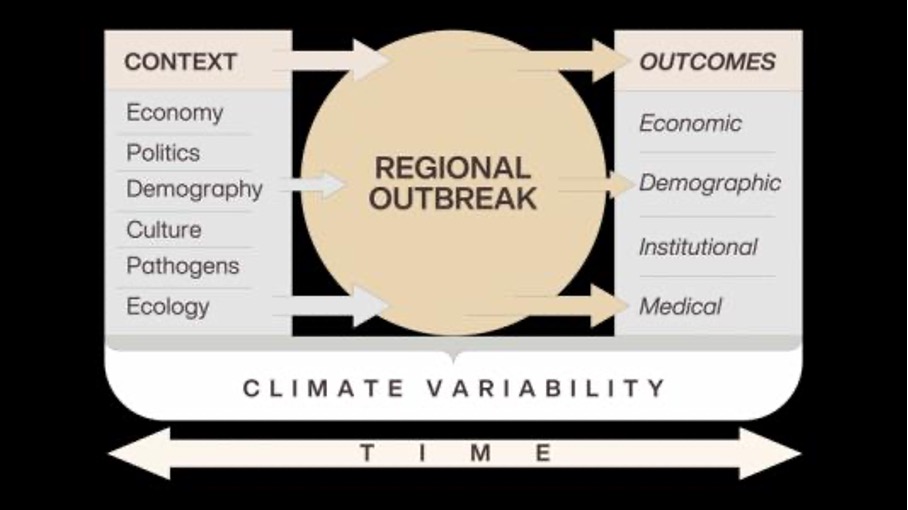
Born from years of interdisciplinary collaboration, EUROpest aims to articulate the complex ways in which social-ecological systems shape epidemics. It builds on resilience and actor-network theories to advance its own eco-bio-social paradigm that embraces a multi-causal understanding of disease transmission and disease impacts on human societies and ecosystems.
While striving to develop and validate a general theoretical model, it takes the well-documented and highly diverse world of late medieval and early modern Europe as its laboratory – investigating its interconnected climatic, cultural, demographic, economic, ecological, and pathogenic history. With regard to the latter, EUROpest assumes malaria, smallpox, tuberculosis and enteric diseases were major components of a disease baseline over which the most devastating disease, plague (Y. pestis), occurred.
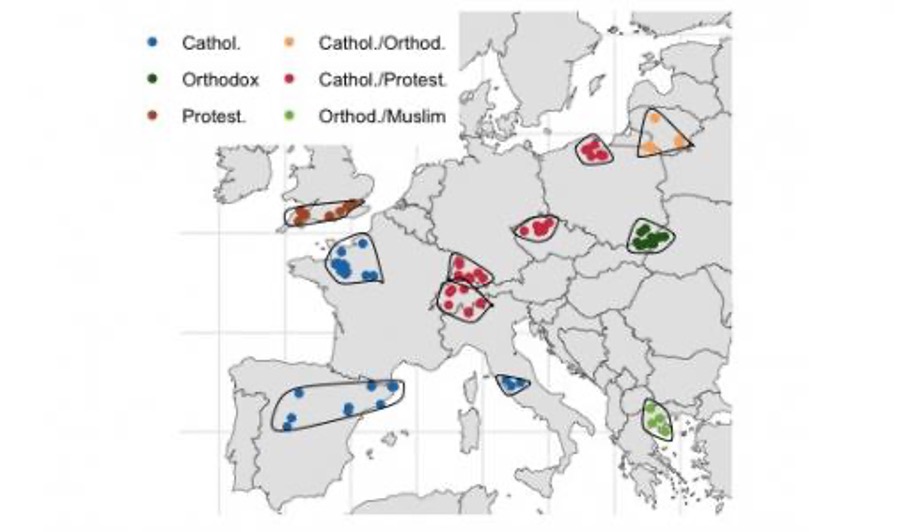
EUROpest will carry out regional case studies – from Spain to Lithuania, Greece to England – selected on the basis of available and procurable written, scientific and archaeological data. It will holistically consider the contexts of plague outbreaks identified in those regions, to understand how context both facilitated outbreaks and also shaped them, and their short- and medium-term impacts.
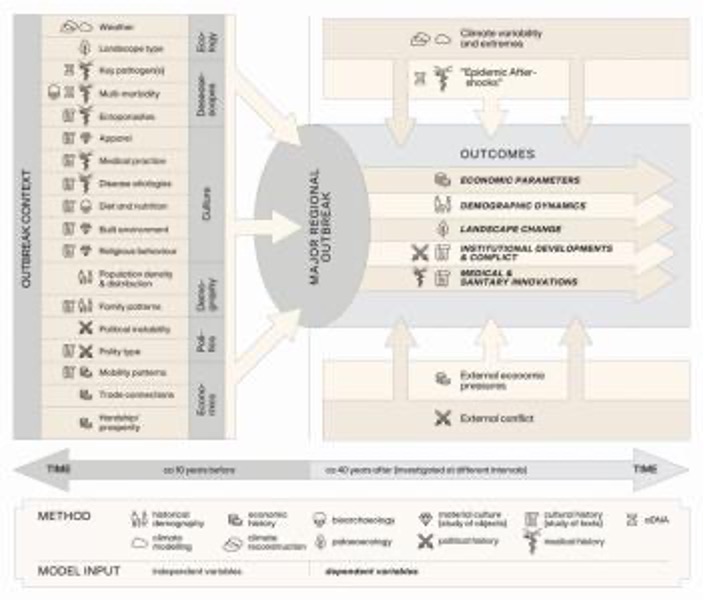
EUROpest combines archival source analysis with archaeology, archaeogenetics, paleoecology and paleoclimatology, and subjects case studies to novel human-supervised machine-learning to identify the causal role of factors influencing regional outbreaks.
As the contemporary imagination is guided in its understanding of epidemic disease by the outbreaks of the past, EUROpest’s contribution will be critical to developing more nuanced and realistic scenarios of future pandemics, academic as well as popular. With EUROpest PIs already engaging policy makers, the mathematical precision of the eco-bio-social analysis EUROpest proposes will help design more successful and targeted interventions for future pandemic response.
The EUROpest project is carried out collaboratively within a broad consortium, led by Nicolaus Copernicus University alongside the Max Planck Institute for Evolutionary Anthropology in Leipzig, The Euro-Mediterranean Centre for Climate Change (CMCC) and Department of History at Georgetown University in Washington. The respective teams are headed by Dr. Alexander Herbig, Dr. Elena Xoplaki, and Prof. Timothy Newfield. Our partners within the project include University of Latvia, Institute of Geography and Spatial Organization of the Polish Academy of Sciences, National Centre for Scientific Research, University of Bialystok, Leibniz Institute for the History and Culture of Eastern Europe, University of Zaragoza, and University of Tübingen.